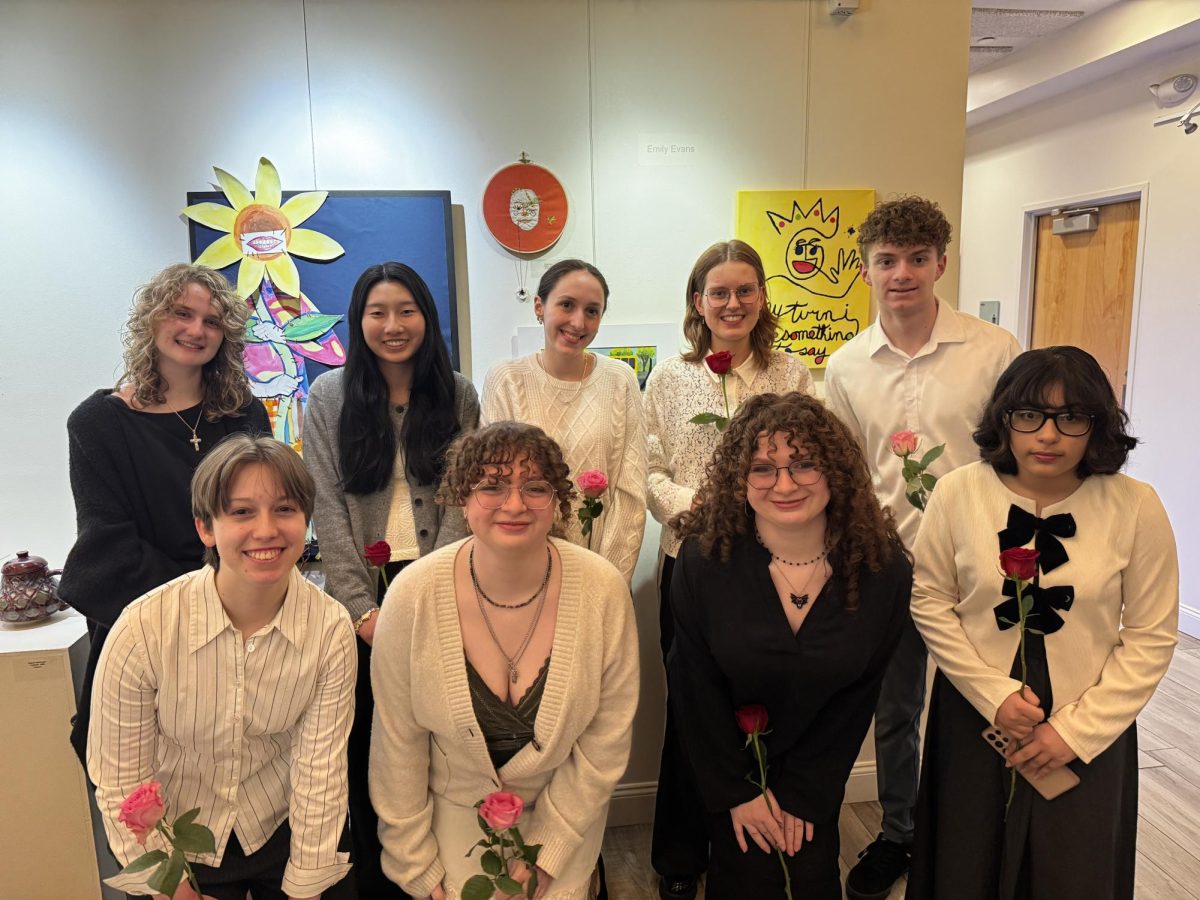
On Thursday, March 12, the Honors Art Exhibition in the Hopkinton Center for the Arts concluded its most recent of around 22 years of showings with its traditional closing ceremony.
The exhibition is a culmination of much of the year’s work for many AP Art students, who are specially chosen by art educators Kris Kellenberger and Sterling Worrell. Both teach a variety of classes, but most significantly, AP Art and Photography, respectively.
“Around 2004, I started this show for our students,” Worrell said.
Worrell began the collaboration between the school and what was then the CAA, before the creation of the HCA. Since then, Worrell and Kellenberger swap roles as the main curators of the show every other year.
“Ms. Kellenberger and I put it together. For the most part, it’s her painting and drawing students and my photography students. Every once in a while, we have some ceramics students, too.”
“I sort of stepped into the role of coordinating with him since I taught Advanced Placement,” Kellenberger said.
This year’s coordination fell to Ms. Kellenberger.
“My role is to help the kids select what’s going to be most appropriate for the show. Preferably something that demonstrates their personal voice, rather than something that was in class for an assignment – or something that rises to the level of demanding to exist beyond an assignment,” Kellenberger said.
Getting selected to be a featured artist is challenging. A student must either take AP Art or Photography and must be invited by one of the teachers to participate. The invitation requires meeting specific criteria.
“These are students who have all demonstrated commitment to an excellence in the arts over their high school career. At this point, they’re usually creating a body of work that is exploring something personal to them,” Kellenberger said.
“They have to have excellent work ethic, be responsible, and reliable.”
For senior Emily Evans, getting selected was as exciting as creating the work itself.
“At first, I was excited, but I didn’t realize it was an actual, professional setting. It feels pretty cool,” Evans said.
“I’ve been told that people are talking about it, which is very interesting, because it’s like a journal entry for me. To have it out in the world and have people seeing it feels kind of weird, but it’s also cool.”
After the initial selection, students must begin creating their works, both inside and outside of class.
“I usually think of ideas for pieces while I’m walking my dog. Then I sketch them and dive right in. I don’t spend too much time on planning. I tend to use a lot of bright colors and multi-media,” Evans said.
However, every student has a different process. For AP Art student Lila VanBeek, inspiration comes differently.
“I usually get an idea and roll with it. I sketch out a couple ideas and find one I like best,” VanBeek said.
“Since I like to work with 2D and 3D, I try to make off-the-paper elements. Whether it be a giant wrench or a watercolor, there’s no in-between,” said VanBeek.
Once the pieces are finished, Kellenberger helps students take the final step.
“I show them how to prepare the work for a show, including matting the work, mounting it on cardboard, and installing hardware,” Kellenberger said.
“Then, we talk about what installation looks like when you collaborate with a bunch of people to put something up in a gallery. And they come over here and install the work.”
Once a student is featured in the exhibition, the job is not done.
“All along, they are also doing behind-the-scenes work of promoting the show, raising awareness, inviting people, reading all the promotional content, et cetera,” Kellenberger said.
The exhibition is important for the featured students’ families as well. Audrey Evans, Emily’s sister, attended the closing ceremony.
“I feel really proud because I know she has worked very hard to create art, and this means a lot to her. I’m very proud that she is being featured as one of the few artists [in this exhibition],” Evans said.
However, no matter what their role, all involved believe it is an important collaboration with the high school.
“It’s a really rare experience for students to [see] what it’s like to be shown in a professional gallery, what it means to be a practicing artist in a community, and everything that goes with that – the celebratory components as well as the responsibility components,” Kellenberger said.
“It’s also an event that brings the community together in a way that’s really nice.”
“Hopkinton has a great arts program, and I think it’s important to showcase what the students are doing,” Evans said.
“There are lots of opportunities to showcase other things, but a lot of people spend a lot of time and put a lot of effort into things like this. So it’s cool to have it out there.”