Franchonia has become one of Hopkinton High School’s most renowned classroom activities, consuming almost two months of Mr. Franchock’s Advanced Placement Language and Composition class in its first semester.
English teacher Mike Franchock has developed the simulation, creating his own fictional country, Franchonia, as a way to get kids to persuade each other through arguing and debating about rhetoric and politics.
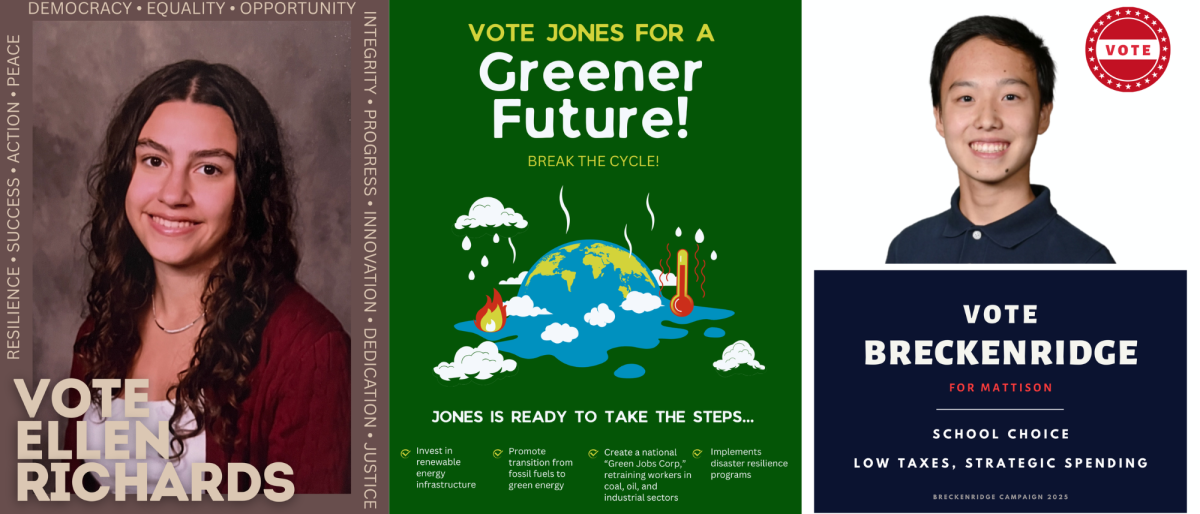
The simulation gives teams creative freedom to create advertisements and compels them to use language manipulatively.
“I try to give the kids a lot of different ways to manipulate my fake country into voting for them,” Franchock said.
“They have speeches, and they have debates, and they have people doing shows, and press conferences, and it’s all supposed to simulate the same thing.”
After receiving their party and candidate, students get to take on one of several roles for their team’s campaign, such as Candidate, Vice President, Press Secretary, Campaign Manager, Media Celebrity, and more.
Several students became invested in winning the simulation as it progressed, some spending hours each night creating compelling videos, physical advertisements, speeches, and impressive campaigns for their candidate.
“I realized that there’s a lot more going into a campaign than I thought. [With my role as] a media celebrity, I had to create a lot of ads. We had to make something that was fun that would motivate people to want to vote for Richards,” Franchonia Media Celebrity Addie Morrissey said.
Students watched their argumentation and advertising skills improve throughout the simulation.
“During the first speech, I was kind of nervous,” Morrissey said. “My public speaking got better throughout the campaign because I got more used to being in videos and on a screen while we watched them in class.”
“Franchonia helped develop my organizational capacity and decision-making. I learned how to better rally a team behind a goal,” Candidate Jacob Wu said.
“Everyone is happy pursuing and designating people with different talents to tasks complementary to their talents. And for decision-making, we had to be ready to address scandals, the press, and any random events,” Wu said.
While some of the loudest voices in the class often take on roles as candidates or running mates, Franchock highlighted the importance of students working behind the scenes to impact the success of their team’s campaign.
“I had people that I thought bombed the first time they did their thing,” Franchock said. “Those people walked back up there and did it again and did it again and made it better.”
“We have people behind the scenes that are editing ads, and decide at 11 o’clock, they’re going to make an ad for their team instead of going to bed, because they don’t want to let their team down.”
While only one party per class won the simulation, it was an all-around success, with many students learning new, valuable ways to use language in political rhetoric.